Pour a glass of tap water anywhere in Santa Ana, let it dry on the counter, and a faint white ring is usually left behind. That ring is the plain-language answer to a question plenty of local homeowners eventually ask: how hard is the water in Santa Ana? By the City of Santa Ana's own numbers, the answer is “quite hard” — roughly 250 parts per million of dissolved minerals, or about 15 grains per gallon. That is enough to spot your dishes, cloud your shower glass, and lay down a slow crust of scale inside your water heater. None of it makes the water unsafe; hardness is a household nuisance, not a health risk. This guide covers where that hardness comes from, what it quietly does to a Santa Ana home, why summer makes it worse, and the treatment options that actually fit the problem.
Key Takeaways
- Santa Ana's tap water runs about 250 ppm, or roughly 15 grains per gallon, according to the City of Santa Ana.
- On the U.S. Geological Survey's scale, anything above 180 mg/L is “very hard,” which places Santa Ana well into the hard range.
- Around 77% of the city's supply is local groundwater; the remainder is imported through the Metropolitan Water District.
- Hard water is not a health hazard, but it drives limescale in water heaters, pipes, and fixtures.
- Everyday signs include soap scum, spotty glassware, dry-feeling skin and hair, and heavier soap and detergent use.
- A water test tells you which fix — softener, conditioner, or reverse osmosis — actually matches your home.
How hard is Santa Ana's water, really?
The water in Santa Ana is hard — about 250 parts per million, or roughly 15 grains per gallon, according to the City of Santa Ana's water quality FAQs. For context, the U.S. Geological Survey classifies water as soft up to 60 mg/L, moderately hard from 61 to 120, hard from 121 to 180, and very hard above 180 mg/L. At 250 ppm, Santa Ana's supply lands firmly in the “very hard” band, above the point where most homeowners start to notice the effects. Grains per gallon is the unit installers use, and roughly every 17 milligrams per liter equals one grain, which is why 250 ppm works out to about 15 grains. The city calls its water clean, high quality, and safe to drink, and that is accurate — hardness is tracked because it affects plumbing and cleaning, not because it poses a danger. Knowing the actual number matters because treatment equipment is sized by grains: a system built for 15-grain water is very different from one built for 8-grain water.
Where Santa Ana's hardness comes from
Santa Ana's hardness is mostly a story about groundwater. About 77% of the city's water is pumped from the local aquifer, with the rest imported from the Metropolitan Water District, which blends supplies from the Colorado River and Northern California. That groundwater is part of the Orange County Groundwater Basin, which the Orange County Water District says supplies roughly 85% of the drinking water for 2.5 million people across north and central Orange County. As rain and recharge water move through the soils and rock of the basin, they dissolve calcium and magnesium — the two minerals that define hardness. By the time that water reaches a tap in Floral Park, Downtown, or South Coast Metro, it carries those minerals with it. Imported Colorado River water is naturally mineral-rich as well, so blending does not soften the supply much. That is why hard water is a regional trait rather than a Santa Ana quirk: neighbors in Tustin, Orange, and Garden Grove draw from the same basin and see the same spotting and scale.
Where Santa Ana falls on the hardness scale
Here is where Santa Ana lands compared with the standard USGS hardness scale.
| Classification | Hardness (mg/L) | Grains per gallon |
|---|---|---|
| Soft | 0–60 | 0–3.5 |
| Moderately hard | 61–120 | 3.5–7 |
| Hard | 121–180 | 7–10.5 |
| Very hard | Above 180 | Above 10.5 |
| Santa Ana (city figure) | About 250 | About 15 |
What hard water does to plumbing and appliances
The clearest cost of hard water shows up in equipment. When hard water is heated, dissolved calcium and magnesium drop out of solution and form limescale — the chalky buildup that coats the inside of water heaters, kettles, and pipes. The EPA lists scale and corrosion among the “technical effects” tracked under its secondary standards, the non-health guidelines covering taste, staining, and equipment damage. In a water heater, a scale layer insulates the element or burner from the water, so the unit works harder and runs longer to hit the same temperature — which means higher energy bills and a shorter lifespan. Scale also narrows pipes and clogs aerators, showerheads, and the small valves inside dishwashers and washing machines. Santa Ana has a large stock of mid-century and older homes, and aging copper or galvanized plumbing gives scale even more surface to grab. Fixtures show it first: a crusty ring around faucets, weaker flow at the showerhead, and cloudy spots on glassware that no rinse cycle removes. None of it happens overnight, which is exactly why it is easy to ignore until a water heater fails early.
What hard water does to skin, hair, and laundry
Hard water changes daily routines in smaller but constant ways. Minerals react with soap to form soap scum — the film that dulls shower doors, tile, and glassware — and they keep soap and shampoo from lathering, so most households use more product to get the same result. After a shower, that residue can leave skin feeling tight and hair feeling filmy, a complaint tied to mineral deposits rather than the water being unclean. In the laundry, hard water leaves fabrics stiffer and colors duller over time, which is why many detergents sell “for hard water” formulas. It bears repeating that none of this is a health problem: the USGS notes plainly that hardness is a nuisance, not a health concern, and the calcium and magnesium involved are the same minerals found in food. The effects are about comfort, cleaning, and how long your fixtures and clothes last — not safety.
Why summer makes Santa Ana's hard water more obvious
Santa Ana's semi-arid climate quietly amplifies hard-water problems in the warm months. Summers here are long, hot, and dry, which pushes household water use up — more irrigation, more car washing, more pool topping-off — and every gallon carries the same mineral load. When that water evaporates fast in the heat, it leaves its minerals behind, so spotting turns up quicker on cars, windows, patio glass, and anything rinsed outdoors. Pool owners see it as scale forming at the waterline and on tile. Peak summer demand across Orange County can also lean more heavily on mineral-rich imported supply, which does nothing to lower hardness at the tap. The hardness level itself does not really change with the calendar, but the heat makes its effects far easier to see — which is why late spring and summer are when many homeowners finally decide to deal with it rather than wipe it away one more time.
Your options for treating hard water in Santa Ana
There is no single fix for hard water; the right choice depends on what bothers you most. A salt-based water softener is the only option that truly removes hardness minerals, swapping them for sodium so scale stops forming throughout the house — the standard choice for homes fighting buildup in water heaters and plumbing. If you would rather skip the salt and the brine tank, a salt-free water conditioner does not remove minerals but changes their form so they are far less likely to stick as scale, which suits households focused on protecting equipment. When the main worry is the water heater and appliances specifically, targeted scale prevention can extend their life without treating every tap. For drinking and cooking, a reverse osmosis system under the sink strips out dissolved minerals and much more, delivering crisp, low-mineral water at one faucet — a common pairing with a whole-home softener. The smart first step for any of these is a water test: knowing your exact grains-per-gallon number, plus any iron, chlorine, or TDS readings, is what tells you whether you need whole-home treatment, a drinking-water unit, or both. Guessing usually means buying too much system, or too little.
Living with 15 grains — and when it's worth treating
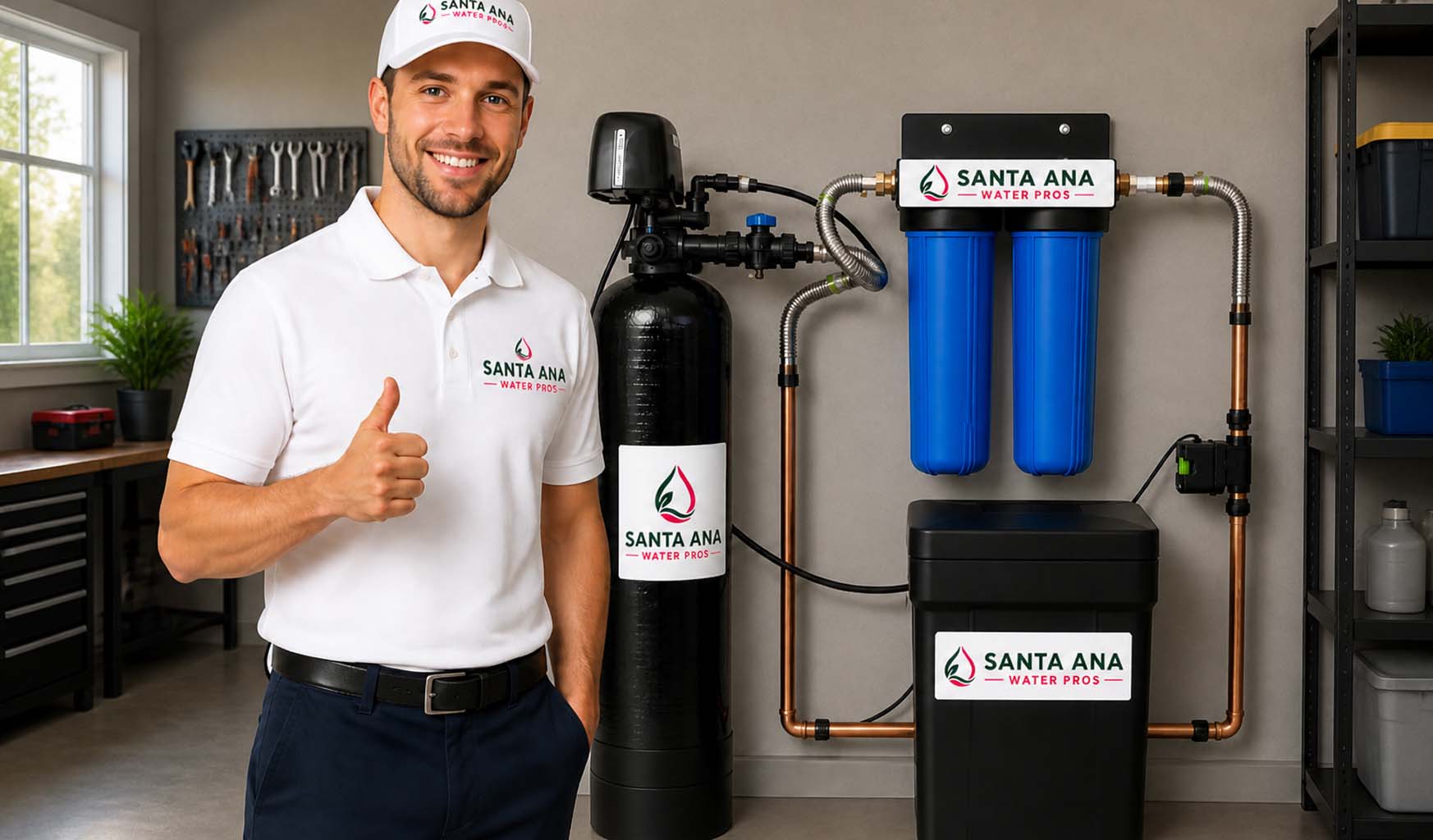
Hard water in Santa Ana is not going away; it is baked into the groundwater the whole region shares. The practical question is not whether your water is hard — at roughly 15 grains per gallon, it is — but how much its effects are costing you in energy, repairs, soap, and hassle. If your water heater is aging, your fixtures crust over, or your skin and laundry never feel quite right, those are the signs that treatment will pay off rather than reasons to keep coping. Start by confirming your own numbers, then match the fix to the problem instead of the other way around. When you want that done on-site, Santa Ana Water Pros can test your water and walk you through water softeners, salt-free conditioners, and reverse osmosis for your specific home.
City of Santa Ana — Water Quality FAQs; U.S. Geological Survey — Hardness of Water; Orange County Water District — About; U.S. EPA — Secondary Drinking Water Standards.