If you have lived in Santa Ana for more than a season, you already know the water leaves its mark: spots on the glassware, a film on the shower door, soap that never quite rinses away. So you start shopping for a fix, and within minutes you hit the same fork every local homeowner hits. Do you need a water softener, a water filter, or both? The two get lumped together in ads and showroom displays, but they solve genuinely different problems, and buying the wrong one is an easy and expensive mistake. This guide lays out what each system actually does, which one fits Santa Ana's very hard, groundwater-fed supply, and how to tell what your own home needs before you spend a dollar.
Key Takeaways
- A water softener removes hardness minerals, calcium and magnesium, through ion exchange; a water filter removes contaminants that affect taste, odor, or safety. The two are not interchangeable.
- Santa Ana's tap water runs about 15 grains per gallon, which is very hard by the national scale, so most local homes see a real benefit from softening.
- Hardness is an aesthetic nuisance rather than a health risk, while filters address different concerns such as chlorine taste, sediment, or specific contaminants.
- A softener protects plumbing and appliances throughout the whole house; a drinking-water filter improves the water at one tap.
- Plenty of Santa Ana households end up using both: a softener for the whole house and a filter at the kitchen sink.
- A water test is the only way to learn your exact numbers and avoid over-buying or under-buying.
What does a water softener actually do?
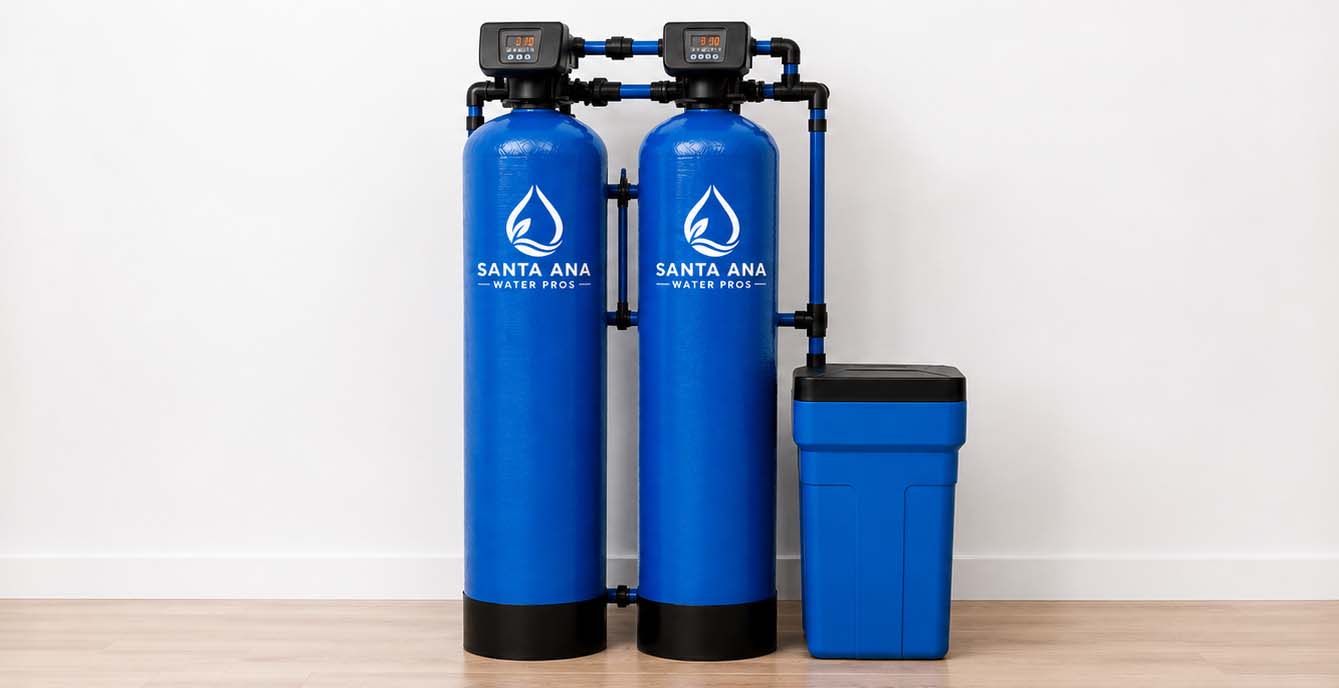
A water softener removes the dissolved calcium and magnesium that make water hard, and little else. As the Minnesota Department of Health explains, softeners, also called ion exchange units, pass water over resin beads that trap calcium and magnesium and swap them for a small amount of sodium or potassium. The water that comes out is soft: it no longer deposits the chalky scale that builds up inside water heaters, narrows pipes, and crusts around faucets and showerheads. That is the specific job a softener is built for, and in a city with 15-grain water, it is a big one. Soft water also lets soap and detergent lather properly, so you use less of both and spend less time fighting spots on dishes and glass. What a softener does not do is improve taste, remove chlorine, or strip out sediment and other contaminants; it swaps minerals for sodium and is not a purifier. If your main complaint is scale and spotting, professional water softener installation is the fix that solves it at every tap in the house.
What does a water filter actually do?
A water filter removes contaminants and impurities from water, but it does not remove hardness. Exactly what a filter takes out depends on its media. An activated carbon filter reduces chlorine along with the taste and odor that come with it; a sediment filter catches sand, silt, and rust; a reverse osmosis system pushes water through a membrane to strip dissolved solids down to the molecular level; and a UV unit neutralizes bacteria. Filters target the things you can taste, smell, or that raise a safety question, which is a different category of problem from hardness. The U.S. Environmental Protection Agency classifies hardness and the scale it causes as aesthetic, non-health effects under its secondary standards, separate from the contaminants that drive most filtration. In practice, a carbon or reverse osmosis filter will give you cleaner, better-tasting drinking water, but it will not stop the scale forming in your water heater. Filters and softeners answer different questions, which is exactly why so many homeowners get the choice wrong.
Softener vs. filter at a glance
| Question | Water Softener | Water Filter |
|---|---|---|
| What it targets | Hardness minerals (calcium, magnesium) | Contaminants: chlorine, sediment, taste, odor |
| How it works | Ion exchange (resin and salt) | Carbon, sediment, RO membrane, or UV |
| Where it treats | The whole house | One tap, or whole-house by type |
| What it will not do | Remove chlorine or improve taste | Stop scale or soften water |
Which does a Santa Ana home actually need?
For most Santa Ana homes, the honest answer is a softener first. The City of Santa Ana reports that its water is about 15 grains per gallon, roughly 250 parts per million, with about 77 percent drawn from local groundwater and the rest imported through the Metropolitan Water District. On the U.S. Geological Survey scale, anything above 180 milligrams per liter is very hard, which places the city firmly in that band. At that level of hardness, scale is the dominant, house-wide problem: it shortens the life of water heaters, clogs fixtures, and leaves the spotting and stiff laundry that send people shopping in the first place. That groundwater comes from the Orange County Groundwater Basin, the same source that leaves neighbors in Tustin, Orange, and Garden Grove with identical complaints, so this is a regional trait, not bad luck. If what bothers you is buildup, spotting, and soap that will not lather, a softener matches the problem. If instead your water tastes of chlorine, carries sediment, or you simply want cleaner drinking water, a filter is the better first move. The symptom points to the system.
When do you need both, and when don't you?
You need both when you want to protect the whole house from scale and also want noticeably better drinking water. A very common Santa Ana setup pairs a whole-home softener, which handles hardness at every tap, with an under-sink reverse osmosis filter that polishes the water you actually drink and cook with. The softener guards the plumbing and appliances; the filter handles taste and whatever the softener leaves behind. You probably do not need both if you have only one concern. A renter who cannot install whole-house equipment, a household that only wants crisp drinking water, or a home that already has soft water can get by with a single filter. Likewise, if scale is your only issue and you are happy with how the water tastes, a softener alone is enough. Doubling up makes sense when your problems come from two different sources, not as a default upgrade.
How do you decide? Start with a water test
The fastest way to settle the question is to test your water rather than guess. A water test tells you your exact grains-per-gallon hardness, plus readings for chlorine, total dissolved solids, iron, and other contaminants that a softener will never touch. Those numbers turn a vague sense that the water seems bad into a specific plan: a 15-grain reading points clearly to softening, while a strong chlorine taste or a high TDS number points to filtration, and seeing both means you likely want a softener and a drinking-water filter working together. Sizing matters too, because a softener built for 15-grain water is very different from one built for 8-grain water. Guessing usually means buying more system than you need, or too little to fix the problem. A quick on-site test removes that risk before you commit.
Frequently Asked Questions
Does a water softener also filter my water?
Not in the way most people mean. A softener removes calcium and magnesium through ion exchange, which stops scale, but it does not remove chlorine, improve taste, or take out most contaminants. If you want cleaner-tasting drinking water, you pair the softener with a filter.
Will a water filter get rid of hard-water scale?
No. Standard carbon, sediment, and even reverse osmosis filters are designed to remove contaminants, not the dissolved minerals that cause hardness. Only a softener, or a dedicated salt-free conditioner, changes how those minerals behave so scale stops forming throughout the house.
Do I need a softener if I only care about drinking water?
Probably not. If your goal is better water at the kitchen tap and you are not worried about scale elsewhere, an under-sink reverse osmosis or carbon filter can give you that without a whole-home softener. A softener earns its place when hardness is damaging appliances house-wide.
Is Santa Ana's water safe to drink without any treatment?
Yes. The city treats its supply to meet state and federal safety standards, and hardness is tracked as a nuisance, not a health hazard. Softeners and filters in Santa Ana are about comfort, equipment protection, and taste, not about making unsafe water safe.
City of Santa Ana — Water Quality FAQs; U.S. Geological Survey — Hardness of Water; U.S. EPA — Secondary Drinking Water Standards; Minnesota Department of Health — Home Water Softening.